
Toyota Altezza RS200
Rear-Drive Sport Sedan · 1998–2005
Toyota Altezza RS200 (XE10)
Japan's rear-wheel-drive answer to the BMW 3 Series — a titanium-valved, 7,600-rpm four with a 6-speed manual, the car America only ever got as a straight-six Lexus.
The Story
By the late 1990s the rear-wheel-drive Japanese sport sedan had all but vanished. Toyota brought it back — and handed the job to the engineer who built the AE86. This is our full review and buyer's guide to the Altezza RS200.
Launched on October 30, 1998, the Altezza (chassis XE10) was Toyota's deliberate revival of the affordable, driver-focused rear-drive saloon. The brief, in Toyota's own words, was to offer “the pleasure of driving and controlling a fast car at will.” To get there the engineers shortened the wheelbase against the car it replaced, widened the track, and slid the engine back behind the front axle line — a front-midship layout aimed squarely at near-50/50 balance.
The man in charge was Nobuaki Katayama, and his CV tells you everything about the car's intent. Before the Altezza he had been the chief engineer behind the Toyota AE86 Corolla — the lightweight, tail-happy coupe that defined a whole culture of Japanese rear-drive driving — and he worked on the A80 Supra and the Lexus SC. The Altezza was his attempt to pour that same spirit into a practical four-door. Japan agreed: it was named Japan Car of the Year for 1998–1999.
“The Altezza was the AE86 engineer's attempt to give a four-door the soul of a sports car.”
Design & The Shape
“Altezza” is Italian for “height” or “nobility” — Toyota borrowed the language of Ferrari and Lamborghini to signal that this was a cut above an ordinary saloon. The styling is taut and compact: at 4,400 mm long on a 2,670 mm wheelbase, the Altezza is actually a touch smaller than its target. A period review measured the IS/Altezza family at 71 mm shorter, 19 mm narrower and 5 mm lower than the contemporary BMW 3 Series (E46) — a genuinely small, tightly packaged car.
But the single most influential thing about the design is at the back. The Altezza introduced clear-lens tail lights to the world in October 1998, and the look detonated. Within a couple of years the aftermarket was selling clear-lens “Altezza lights” for Honda Civics, Mitsubishi Evos, the Mazda MX-5 and almost anything else with a bumper. The car gave its own name to an entire styling era — one that, ironically, outlasted the trend and the car itself.

Inside, the same clear-lens design language carried over to a distinctive instrument cluster, part of a cabin built around the driver. The RS200 — the top grade — got sport bucket seats and the hardware to back up the looks. This was never meant to be a soft commuter; everything points at the road.
The BEAMS 3S-GE
The RS200's reputation lives or dies on one component: a 2.0-litre four-cylinder that revs like a motorcycle.
The engine is the fifth-generation 3S-GE, known by its black cam cover as the “Blacktop,” built under Toyota's BEAMS program — Breakthrough Engine with Advanced Mechanism System. It is a 1,998 cc DOHC 16-valve inline-four with a perfectly square 86.0 x 86.0 mm bore and stroke, co-developed with Yamaha. What makes it remarkable is the spec sheet: dual VVT-i on both intake and exhaust cams, an 11.5:1 compression ratio, and — the headline — titanium intake and exhaust valves, exotic motorsport hardware on a family-sized sedan, used to cut valvetrain mass so the engine can spin freely.
Why this engine is special
This exact version of the 3S-GE was built for one car only:
- Exclusive to the RS200: the Gen-5 “Blacktop” BEAMS four was fitted to no other Toyota or Lexus production model. If you have this engine, you have an Altezza RS200.
- Manual-only hardware: the 6-speed manual car's engine is the high-output tune — titanium valves, stiffer springs, 11.5:1 compression — making 210 PS (207 hp) at 7,600 rpm. The 5-speed automatic RS200 used a milder 200 PS tune at 11.1:1.
- Rev-happy by design: peak power arrives high, at 7,600 rpm, with 216 Nm (159 lb-ft) of torque at 6,400 rpm. You drive it on the cams, the way Katayama intended.
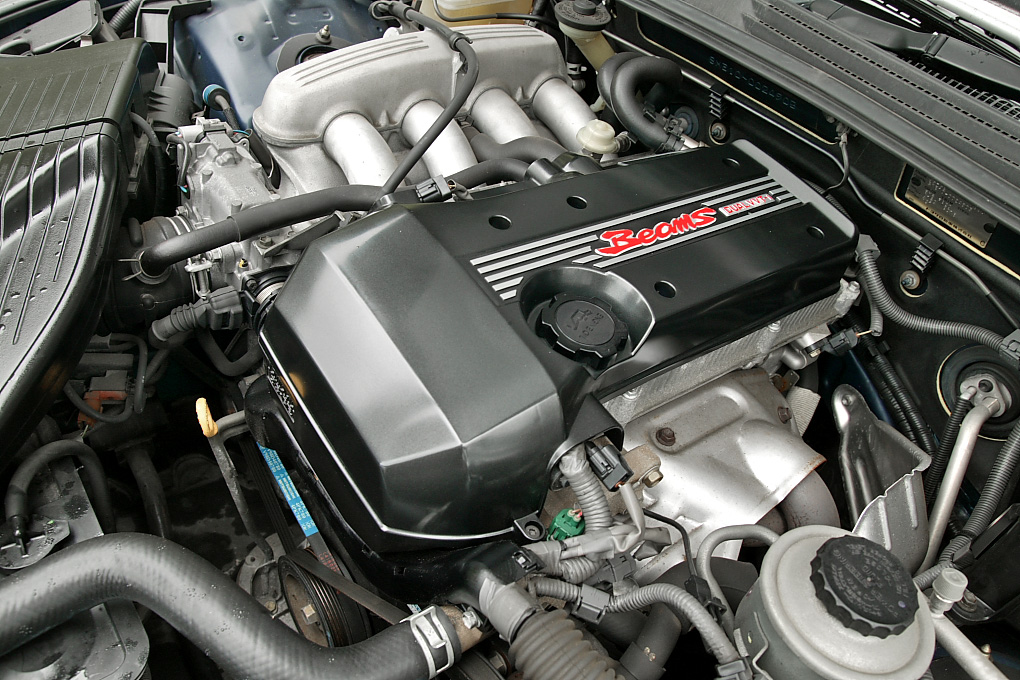
Note the orientation: in the Altezza the 3S-GE is mounted longitudinally to drive the rear wheels — not the transverse, front-drive layout this engine family usually wore. That, plus titanium valves to chase the redline, is a long way from an ordinary Toyota four.
Performance & Driving
On paper the numbers are modest: 0–60 mph in roughly 7.8 seconds for the 6-speed manual. But raw acceleration was never the point of a 2.0-litre naturally aspirated sedan. The point is how it gets there — a chassis tuned for balance and an engine that begs to be wound out.
Underneath sits a double-wishbone front and a multi-link independent rear (a detail often misreported as wishbones all round), rack-and-pinion power steering, and 215/45 R17 tyres on a 1,340 kg (2,954 lb) car. Combined with the front-midship engine placement, that gives the near-50/50 weight distribution enthusiasts prize. It is a small, light, neutral rear-driver — exactly the recipe that made the Altezza a fixture of Japanese touge runs and amateur circuit days.
The class context, honestly
Toyota built the Altezza to take on the compact European sport sedans, and a contemporary review placed it directly in 3 Series territory while noting it was the smaller, tighter car. We will leave the head-to-head road-test verdicts to the magazines of the day — what is not in doubt is the formula: rear-wheel drive, a free-revving twin-cam four, a slick 6-speed manual and a balanced chassis, in a four-door you could use every day. Few cars of its era and price offered all four at once.
The Lexus Twin
Here is the part that confuses everyone. Toyota sold this body around the world — but in North America it became the first-generation Lexus IS, and it is mechanically a different animal. The US car was the IS300, powered by a 3.0-litre 2JZ-GE inline-six — the same engine family as the naturally aspirated Supra — rated around 215 hp and paired, at launch, with a 5-speed automatic.
So the famous Japan-spec recipe never crossed the Pacific. America never officially got the high-revving BEAMS four, and it never got the 6-speed manual behind it. (A 5-speed manual did arrive late on the US IS300 sedan for the 2002 model year — but bolted to the 2JZ-GE six, not the four.) Same handsome body, two completely opposite characters: a torquey straight-six automatic in the States, a screaming titanium-valved four with a stick shift in Japan. If you want the real RS200, you import it.
“Same body, opposite souls: a straight-six automatic in America, a 7,600-rpm titanium-valved four in Japan.”
Why Import One
The Altezza RS200 has only just become reachable for US buyers. Under the federal 25-year rule a car becomes exempt from FMVSS and EPA requirements once it turns 25, with no Registered Importer needed and just a 2.5% federal duty at the port. The earliest 1998 Altezzas crossed that line in 2023; a 1999 car like ours became eligible in 2024. Clean Japanese-market examples are reaching American driveways for effectively the first time.
That timing matters because values are moving. Manual RS200s already command a 20–30% premium over the automatics, and original, unmodified cars carry a further premium. The rear-drive, BEAMS, 6-speed combination is exactly the spec the import market has started to recognise as special — and once registered, the paperwork is the standard HS-7 and EPA 3520-1 at the port. As a grey-import it will still need state-specific registration (California buyers should confirm CARB/BAR direct-import eligibility first), and that is precisely the kind of import Octane handles end to end.
Where Can You Take It?
A light, neutral, rear-drive sedan with a free-revving twin-cam and a 6-speed — the Altezza RS200 is a blank canvas, and the scene has explored every corner of it from grassroots drift to forced-induction six-cylinder swaps.
Grassroots slider
The short-wheelbase RWD chassis, near-50/50 balance and a manual gearbox make the Altezza a long-running favourite for entry-level drift and mountain-pass runs. Add a welded or plate diff, coilovers and angle, and it slides as readily as the cars it shares a scene with.
1JZ / 2JZ six
Because the engine bay was designed around a longitudinal layout, the Toyota 1JZ-GTE and 2JZ-GTE turbo straight-sixes are a popular and well-documented swap. Owners chasing serious power drop in a turbo six to leave the high-revving four behind for big, easy torque.
Track-day weapon
The double-wishbone front, multi-link rear and balanced chassis respond well to coilovers, stickier rubber, bracing and bolt-on aero. Light and neutral from the factory, a sorted RS200 is a genuine amateur circuit and time-attack tool.
Keep the four, sharpen it
Owners who keep the titanium-valved 3S-GE chase the redline harder with individual throttle bodies, uprated cams and a freer exhaust. It stays naturally aspirated and rev-happy — the purist route that leans into what the BEAMS engine does best.
Clean sport sedan
The crisp Altezza shape suits a tidy show build: a coilover or air drop, the right offset wheels and a subtle lip kit. Fitting that it leans on its looks — this is the car whose clear-lens “Altezza lights” named an entire styling era.
Did You Know?
The Altezza launched on October 30, 1998 and was named Japan Car of the Year for 1998–1999.
Same body, two engines: the Japan RS200 runs a high-revving 2.0L four; the US Lexus IS300 ran a 3.0L straight-six from the Supra family.
The Gen-5 “Blacktop” 3S-GE BEAMS was built exclusively for the RS200 — no other Toyota or Lexus production car got it.
The 6-speed manual car uses titanium intake and exhaust valves — motorsport hardware on a family sedan — to chase a 7,600-rpm power peak.
It gave its name to a styling era: the Altezza's clear-lens “Altezza lights” were soon sold for nearly every car on the market.
Chief engineer Nobuaki Katayama also led the legendary AE86 Corolla — and worked on the Supra and Lexus SC.
“Altezza” is Italian for “height / nobility” — the same Italian-name logic Ferrari and Lamborghini use for drama.
A front-midship layout places the engine behind the front axle line, helping deliver the near-50/50 balance the chassis is built around.
Gallery

Frequently Asked
Is the Toyota Altezza RS200 legal to import to the USA?
Yes. Under the US 25-year rule, the earliest 1998 Altezzas became eligible in 2023 and a 1999 car became eligible in 2024. No Registered Importer is required, federal duty is 2.5%, and it clears on the standard HS-7 and EPA 3520-1 forms. As a grey import it still needs state-specific registration; California buyers should confirm CARB/BAR direct-import eligibility first. Octane handles the entire import for you.
How much power does the Altezza RS200 make?
The 6-speed manual RS200 makes 210 PS (207 hp) at 7,600 rpm with 216 Nm (159 lb-ft) of torque, from its high-compression titanium-valved 3S-GE BEAMS. The 5-speed automatic RS200 used a milder tune of around 200 PS. The power figure you see depends on which gearbox the car has.
Did America get the Altezza RS200?
Not as the RS200. The same body was sold in North America as the first-generation Lexus IS300, but with a 3.0-litre 2JZ-GE inline-six (from the naturally aspirated Supra family) and, at launch, an automatic. The BEAMS four-cylinder and the 6-speed manual never came to the US. A 5-speed manual arrived late on the 2002 IS300 sedan, but behind the six, not the four.
What makes the BEAMS 3S-GE special?
The fifth-generation Blacktop 3S-GE BEAMS was built exclusively for the Altezza RS200 and used in no other production car. The manual car's high-output version runs dual VVT-i, an 11.5:1 compression ratio and titanium intake and exhaust valves, allowing a 7,600-rpm power peak that was exceptional for a naturally aspirated 2.0-litre of its era.
Where do the Altezza tail lights come from?
They started here. The Altezza introduced clear-lens tail-light clusters in October 1998, and the look spread so widely through the aftermarket that Altezza-style clear-lens lamps were soon sold for almost any car. The term outlived the trend, and the original car is now a sought-after import.
Is the Altezza RS200 a good handling car?
It was engineered to be. It uses double-wishbone front and multi-link rear suspension, a front-midship engine placement for near-50/50 balance, rear-wheel drive and a 6-speed manual, in a light 1,340 kg body. That balance is why it became a staple of Japanese touge driving and amateur circuit events.