
Daihatsu Mira Gino L700
Retro Kei Charmer · 1999–2004
Daihatsu Mira Gino (L700)
A pint-sized retro hatch with Italian design roots and a 660cc heart — Daihatsu's stylish answer to the question of how charming a kei car can really be.
The Story
Most kei cars are designed to be invisible — cheap, tiny, and purely practical. The Daihatsu Mira Gino set out to be the opposite: a kei car you actually want to look at. This is our full review and buyer's guide to the L700-generation Gino.
Launched in March 1999 and built through June 2004, the first-generation Mira Gino took the humble bones of the Daihatsu Mira and dressed them in something far more charming — round headlights, chrome accents, a softly curved roofline and two-tone paint. It arrived right in the middle of a late-1990s wave of retro-styled Japanese kei cars, and it was Daihatsu's most style-led entry into that trend: a premium little hatchback that competed on looks and character rather than outright utility.
The name itself signals the intent. “Gino” carries aristocratic, “well-born” connotations in Italian — a fitting badge for a car positioned as the upmarket, design-forward member of the kei class. Two and a half decades on, a clean L700 Gino is no longer just a frugal city runabout. It is one of the most affordable and genuinely interesting Japanese imports you can put on a US driveway.
“The Gino set out to be the one kei car you actually want to look at — and it succeeded.”
Design & The Shape
Here is the detail almost everyone gets wrong. The Gino is constantly described as a “Mini tribute,” but Daihatsu's own stated styling reference was not the British Mini at all — it was the 1963 Daihatsu Compagno, the company's first passenger car. The Compagno's grille and rounded body set the template, and that car itself was penned by Vignale, the famous Italian coachbuilder who also styled Ferraris and Alfa Romeos. So the Gino's retro charm has genuine Italian roots — the Mini comparison is secondary, a popular association Daihatsu was happy to play to later rather than the primary inspiration.
The packaging is a small engineering triumph. Japan's kei rules — locked in 1998, the year before the Gino launched — cap a car at 3,400 mm long, 1,480 mm wide, 2,000 mm tall and 660 cc. The Gino's body measures 3,395 mm long and 1,475 mm wide: exactly 5 mm under both the length and width limits. Every legal millimetre was used. The result is a car barely 11 feet 2 inches long that still seats four with a usable hatchback cargo area.

Daihatsu leaned into the British-icon comparison once the public made it, releasing the Minilite Special in 2000 — a limited-edition Gino on Minilite-replica alloy wheels with Mini-tribute badging. It is the clearest sign that the company knew exactly which cultural buttons the little car was pressing.
The 659cc Triple
For something this small, the Gino's engine line-up is surprisingly deep — and the exact unit under the hood is the one thing every buyer must confirm.
All L700 Ginos use a 659 cc EF-series inline-three, but in three distinct states of tune. The standard “Gino” trim — the most common car by far — runs the EF-VE: a DOHC, 12-valve triple making 58 PS (about 57 hp) at a screaming 7,600 rpm, with 64 Nm (47 lb-ft) of torque. The base grade used the simpler EF-SE (SOHC, 6-valve, around 48 PS after its October 2000 update). They look identical from the outside, so do not assume the engine from the brochure.
“The brochure-standard 2000 Gino used the 58 PS EF-VE — the SOHC EF-SE was base-trim only. Confirm the code on the car.”
One important note for our OA012 car and any 2000-year Gino: an early content listing called this an “EF-SE”, but the EF-SE was a base-trim engine, while the standard Gino trim carried the 58 PS EF-VE. The two are easy to mix up and the difference is real (48 PS vs 58 PS), so our staff always verify the exact engine code from the Japanese inspection certificate or the under-hood stamp before publishing a spec.
And yes — there was a hot one. The Gino Turbo used the intercooled EF-DET: a DOHC 12-valve triple making 64 PS (63 hp) and a healthy 106.9 Nm (79 lb-ft) of torque from just 3,600 rpm. A retro-styled kei car with a turbocharger — and, on the right grade, four-wheel drive — is not a combination most people expect.
Driving & Economy
At roughly 750 kg (1,654 lbs), the standard EF-VE Gino is feather-light, which is exactly what makes a 58 PS engine feel willing rather than slow around town. Power goes to the front wheels through a crisp 5-speed manual (a 4-speed automatic was also offered), the suspension is a simple MacPherson-strut front and torsion-beam rear, and the whole car is tuned for the city — nimble, easy to park, and endlessly easy to thread through traffic.
About that fuel economy
The Gino has a reputation as a 50-plus-MPG car, and it deserves a clear-eyed answer. The EF-VE manual was rated at 23.0 km/L on Japan's 10-15 mode test cycle, which converts to about 54 MPG (US). But the 10-15 cycle is an older, optimistic test, so real-world driving lands lower — realistically around 40–46 MPG in mixed use. Either way, it is one of the most economical cars you can legally register in the United States.
The Turbo trades a little of that frugality for shove: rated near 18.8 km/L on the same test cycle, with the EF-DET's torque making it genuinely brisk for a kei car. None of this is about outright speed — the Gino's appeal is character, charm and tiny-footprint usability, not lap times.
Variants Worth Knowing
The L700 Gino range is small but full of surprises, and the rarer trims are a big part of why the car has such a devoted following:
- Gino (standard): EF-VE, 58 PS, FWD, manual or auto — the mid-grade, most-common car.
- Gino (base): EF-SE, ~48 PS, FWD — the entry grade.
- Gino Turbo: EF-DET, 64 PS, FWD or 4WD, 5-speed manual (1999–2000) or 4-speed auto — the performance top-spec.
- Minilite Special (2000): limited edition on Minilite-replica alloys with Mini-tribute badging.
- Hello Kitty Edition (2001): a genuine factory collaboration car — not an aftermarket wrap.
- Gino 1000: the oddball. From August 2002 it used a 989 cc EJ-VE engine — over the kei limit — for buyers who wanted the look with a bit more grunt. Just 1,292 were built, making it genuinely rare.
Why Import One
The Mira Gino was a Japan-market-only car. It was never officially exported under the Gino name, never rebadged as a Lexus, never sold here in any form — so the only way to own one in the States is to import it. That is precisely the kind of car Octane handles end to end.
And the timing has finally arrived. Under the US 25-year rule, a vehicle becomes exempt from FMVSS and EPA requirements once it turns 25, and eligibility rolls month-by-month by build date. That means 2000-model Gino cars became legal to import across 2025 — a car built early in 2000 cleared early in 2025, one built late in 2000 later that year. No Registered Importer is required and the federal duty is just 2.5%. One state-level note: a kei car's titling and registration rules vary by US state, so buyers should confirm local kei requirements before purchase.
“A Japan-only retro kei car, newly importable, for the price of a used commuter — that is the Gino's pitch.”
Where Can You Take It?
At well under 1,500 lb with a willing little triple, the Mira Gino is a featherweight blank canvas — and the cute-kei scene has run it in a few well-worn directions, from slammed show cars to a genuinely quick turbo swap.
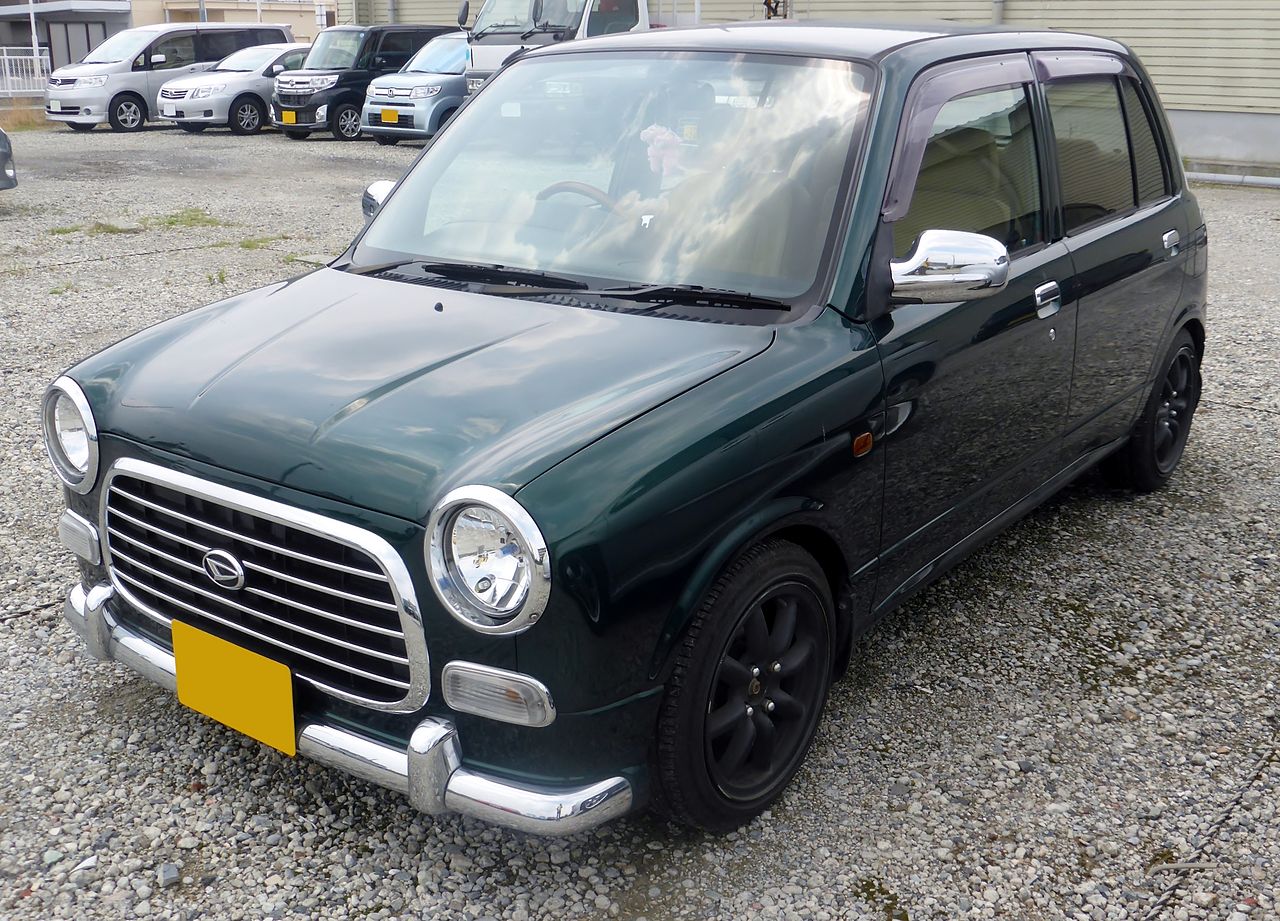
Slammed Retro Show Car
Drop it on coilovers or air, tuck a set of small-diameter retro-look wheels under those round arches, and the Gino becomes a darling of the cute-kei show scene. Its tall, friendly proportions make a hard slam read as charming rather than aggressive — exactly the look this crowd chases.
EF-DET Turbo Triple
Swap in Daihatsu's turbocharged EF-DET 660cc triple — the same family that powered the hot Mira variants — for a genuinely quick micro-car. In a sub-1,500 lb shell, even kei-capped boost turns the Gino into a surprisingly rapid little point-and-squirt machine.
Compagno-Style Restomod
Lean into the classic styling the Gino was built to evoke — the 1963 Compagno and the old Mini — with period details: chrome trim, two-tone paint, a wood-and-chrome cabin, and correct small-cap wheels. A clean restomod plays the retro brief straight rather than fighting it.
Featherweight Corner Carver
At under 1,500 lb the Gino is cheap to make fun in the corners. Sticky tyres, a set of lowering springs or coilovers, and stiffer bushings wake up the chassis for autocross and grassroots events — you exploit momentum and agility instead of power, the classic light-car recipe.
Did You Know?
The Gino's body is 3,395 mm long and 1,475 mm wide — exactly 5 mm under both the kei length and width limits. Every legal millimetre was used.
Daihatsu's official styling reference was the 1963 Compagno — its first passenger car, designed by Italian coachbuilder Vignale. The Mini comparison is a popular misconception.
Daihatsu went full Mini anyway, releasing the Minilite Special in 2000 — Minilite-replica alloys and Mini-tribute badges — once the public made the link.
There was a factory Hello Kitty edition (2001) — a real production car from the Japanese market, not an aftermarket wrap.
There was a Turbo (EF-DET, 64 PS) from launch — and you could even get it with 4WD. A retro kei car with a turbo and all-wheel drive is a rare thing.
The non-kei Gino 1000 (989 cc, 2002–2004) had a total run of just 1,292 units — tiny even by kei-car standards.
The EF-VE manual was rated at 23.0 km/L on Japan's 10-15 test cycle — about 54 MPG. In the real world, expect a still-excellent 40–46 MPG.
Daihatsu traces its roots to 1907 — one of Japan's oldest automakers, predating Toyota by 30 years — and has been part of the Toyota Group since 1998.
Gallery


Frequently Asked
Is the Daihatsu Mira Gino legal to import to the USA?
Yes, under the US 25-year rule. Eligibility rolls month-by-month by build date, so 2000-model Ginos became legal to import across 2025. No Registered Importer is required and federal duty is 2.5%. One caveat: kei-car titling and registration rules vary by US state, so confirm your local requirements. Octane handles the entire import for you.
Was the Mira Gino really inspired by the Mini?
Not primarily. Daihatsu's official styling reference was its own 1963 Compagno — the company's first passenger car, designed by the Italian coachbuilder Vignale. The Mini comparison is real but secondary; Daihatsu leaned into it later with the 2000 Minilite Special, a limited edition with Minilite-replica wheels and Mini-tribute badging.
What engine does the Mira Gino have?
All L700 Ginos use a 659cc EF-series inline-three. The standard Gino trim used the EF-VE (DOHC 12-valve, 58 PS); the base grade used the simpler EF-SE (SOHC, around 48 PS); and the Gino Turbo used the EF-DET (64 PS). Because they look identical, staff confirm the exact engine code on each car before publishing a spec.
Does the Mira Gino really get over 50 MPG?
That number comes from Japan's 10-15 mode test cycle, where the EF-VE manual was rated 23.0 km/L, or about 54 MPG (US). That test is optimistic, so real-world economy is closer to 40 to 46 MPG in mixed driving. Either way, it is one of the most economical cars you can legally register in the United States.
Was there a turbo or 4WD Mira Gino?
Yes to both. The Gino Turbo used the intercooled EF-DET, making 64 PS and 79 lb-ft of torque, and was available with four-wheel drive. Daihatsu also built a limited Minilite Special and a factory Hello Kitty edition, plus the rare non-kei Gino 1000 (989cc) of which only 1,292 were made.
How small is the Mira Gino?
It measures 3,395 mm long and 1,475 mm wide — about 11 feet 2 inches long — just 5 mm under both kei limits. Despite that footprint it seats four and has a hatchback cargo area. The standard car weighs roughly 750 kg (1,654 lbs), which is why a 58 PS engine feels lively around town.